

TL;DR
In 2017 I developed Minerva, a concept for giving people more control over their personal data. Users would have one place to see where data went, decide what they shared and ask companies to delete information again. In 2026, Europe is preparing the EU Digital Identity Wallet. It is a different system, but the idea of putting control over personal information back on the user side feels very familiar.European Commission: EUDI framework and timeline
2017: A layer in between
I recently opened a business plan I wrote in 2017.
The project was called Minerva.
The starting point was personal data. We were already giving increasingly large parts of our lives to websites, apps and platforms, while having very little visibility into what happened to that information afterwards.
My idea was to put a layer in between.
What Minerva was meant to do
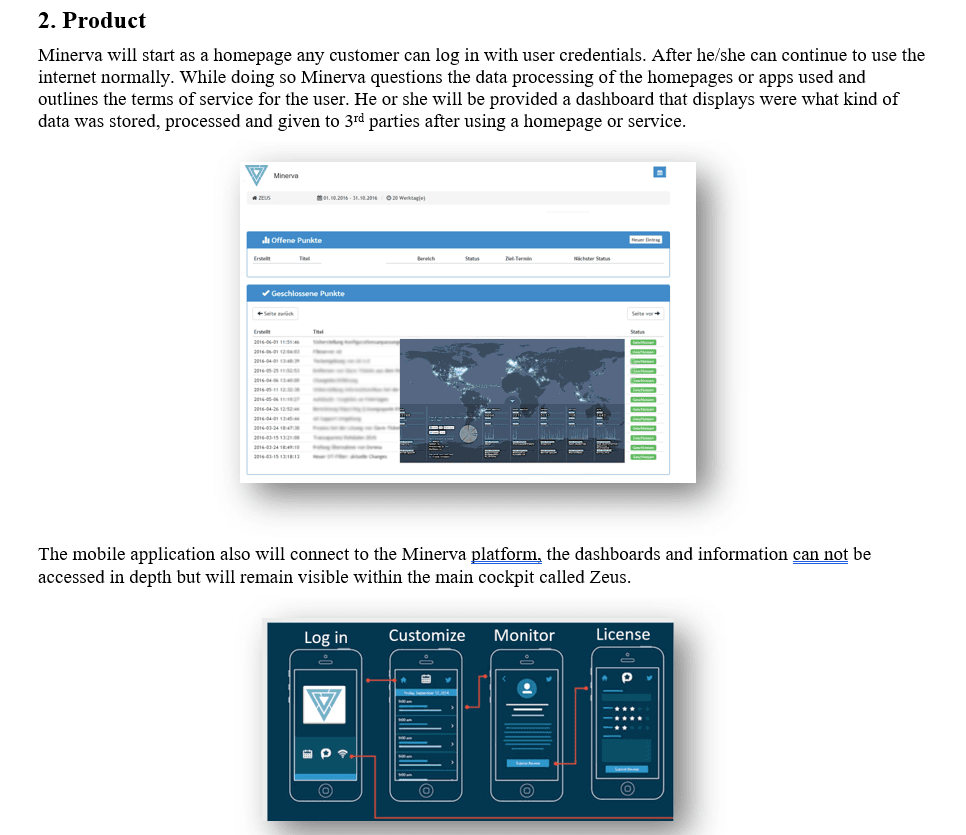
Minerva would give the user one place to see which services had received personal information, where data had moved and what had been shared with third parties. The concept included a web dashboard, a mobile application and different profiles for controlling data sharing. Users should also be able to request deletion of data from companies through the platform.
I went further than that in the original business plan. I thought personal data could eventually be licensed by the user rather than simply handed over as part of using a service. At scale, Minerva was supposed to give individuals more negotiating power over something that companies were already turning into a valuable asset.
The project never became a company.
2026: A familiar idea
Nine years later, I started looking more closely at the European Digital Identity Wallet.
The EU Wallet has a different scope: digital identity and trusted credentials. Proving who you are, storing official documents and sharing specific information with public or private services. The Commission's timeline calls for Member States to provide wallets by the end of 2026.European Commission: EUDI framework and timeline
The part that caught my attention was the control model.
Users should choose which personal information they share. Instead of disclosing an entire identity record, a specific proof can be enough. For example: meeting an age threshold without revealing a name, exact date of birth or other personal details.European Commission: Data control and selective disclosure
Different systems. A similar direction.
That is very close to one of the ideas I was trying to solve with Minerva.
Minerva was much broader: monitoring data flows, managing deletion requests and eventually creating a commercial model around personal data. The EU Wallet is identity infrastructure built around common European rules, standards and trusted credentials.European Commission: Common identity infrastructure
The resemblance is in the principle, not a connection between the projects.
Still, when I put the old Minerva product sketches next to today's wallet concept, the direction is recognisable:
- Give the individual a digital layer that they control.
- Let services ask for information.
- Let the user decide what leaves that layer.
- Share only what is actually required.
The product ages. The question stays.
I find that interesting because Minerva was designed in a very different technological and regulatory environment. GDPR was already in force in 2017, but only became applicable on 25 May 2018. Smartphones, identity systems and privacy regulation have all moved considerably since then.European Commission: When GDPR became applicable
The specific product I imagined in 2017 belongs to that moment.
The underlying question has lasted much longer: How do we give people practical control over their digital identity and personal information?
Back then, my answer was Minerva.
Today, Europe is answering part of that question with a common wallet infrastructure.
Seeing the two next to each other nine years later is a good reminder of something I keep encountering when building products.
You can change almost everything about the implementation and still be working on the same problem.